
Found Survey Markers in Your Yard? Here’s What They Mean
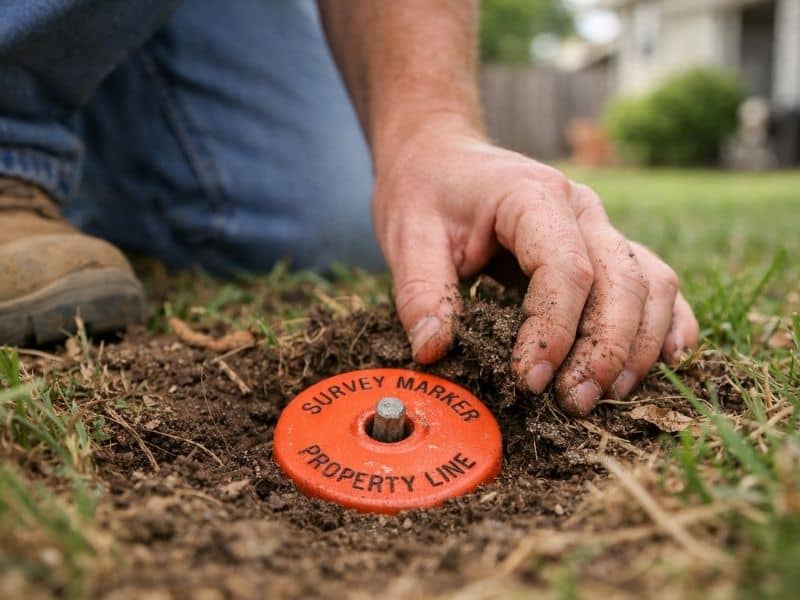
The metal pins, pipes, and small discs you find in your yard are survey markers, also called monuments. A surveyor places them to mark the exact corners and lines of a property. They are the physical proof of where your land sits, and in most places it is against the law to move or remove them.
You are digging a hole for a new plant, and your shovel hits something solid. You clear the dirt and find a metal pin or a small round cap sticking out of the ground. It is easy to ignore, but that little marker may be one of the most important objects on your property. Here is what these markers are, why they matter, and what you should never do with them.
What a Survey Marker Actually Is
A survey marker is a physical object placed in the ground to mark a specific point on a property. Surveyors use them to show exactly where the corners and lines of a parcel sit. Without these markers, property lines would only exist on paper, and it would be hard to prove where one piece of land ends and another begins.
These markers turn the measurements on a survey into real, fixed points you can see and touch. That is why they carry so much weight. When there is a question about a boundary, the marker on the ground is often the clearest answer.
Common Types of Markers You Might Find
Markers come in several forms, and the type often depends on when and where the property was surveyed. Here are the ones you are most likely to run into.
- Iron pins or rebar. These are thin metal rods driven into the ground. They are one of the most common markers on residential property.
- Iron pipes. Older properties sometimes have hollow metal pipes used as corner markers.
- Capped markers. Many pins have a plastic or metal cap on top. The cap is often stamped with the surveyor’s license number.
- Concrete monuments. These are solid blocks set into the ground, usually for larger or more important boundary points.
- Brass or aluminum discs. These flat discs are often set into concrete or pavement and are common at major control points.
If you find a capped marker, the stamp on the cap can tell you which surveyor placed it. That information can be useful if you ever need to confirm or revisit the boundary.
Where Markers Are Usually Placed
Markers are not scattered at random. A surveyor places them at meaningful points so they describe the shape of the property. The most common spots are the corners, where two property lines meet.
You may also find markers along a line, especially on a long boundary where extra points help keep the line clear. Some markers sit at the edge of a road or at the point where your land meets a neighbor’s. Knowing this pattern can help you guess where a marker might be hiding before you start searching.
Why Survey Markers Matter So Much
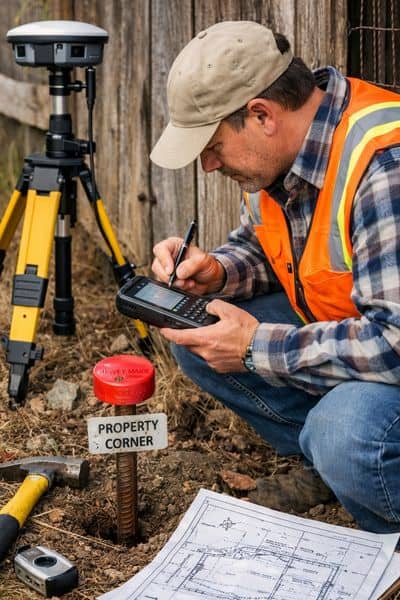
These small objects do a big job. They protect your property rights by giving everyone a clear, agreed point to measure from. When a marker is in place, there is far less room for argument about where a line sits.
Markers matter in many everyday situations:
- Building a fence in the right spot
- Settling a friendly question with a neighbor about a shared line
- Planning an addition that must stay inside your boundary
- Selling your land and proving its limits to a buyer
In each case, the marker is the trusted reference. Losing or moving it can turn a simple project into a confusing and costly problem.
Why You Should Never Move a Marker
This is the part many people do not know. In most areas, it is illegal to remove, damage, or move a survey marker on purpose. These markers are protected because they serve a public purpose, not just a private one. Other people rely on them too.
If a marker is moved, the original point is lost. Restoring it usually means hiring a surveyor to research records and measure the property all over again. That costs time and money, and it can be avoided simply by leaving the marker alone.
So if you find one, the best thing to do is nothing. Do not pull it out, paint over the stamp, or pave over it. If a marker is in your way for a project, talk to a surveyor first. They can advise you on the right and legal way to handle it.
How to Find Your Markers
Sometimes a marker is easy to spot, and sometimes it is buried under grass or soil. If you want to locate yours, start with your survey report. It shows where each marker should be and how far it sits from known points.
Here are a few gentle tips for searching:
- Measure roughly from a known point, such as a corner shown on your survey
- Look for a small cap, pin, or disc near the property corners
- Check along the edge of the yard where lines are likely to run
If you cannot find a marker, it may be buried deeper or it may be missing. In that case, a surveyor can locate the point and, if needed, set a new marker in the correct spot.
When to Call a Professional
You can search for and look at your markers on your own, but some situations call for an expert. If a marker is missing, damaged, or seems out of place, a licensed surveyor is the right person to help. The same is true if you and a neighbor disagree about a line, or if you are about to build close to a boundary.
A quick visit from a surveyor can confirm exactly where your markers belong. That peace of mind is well worth it before you spend money on a fence, a wall, or an addition.